

The Corporate Exodus and the Broken Rung
To understand the surge in entrepreneurship, we must first examine what is driving top talent away from established companies. A stark picture emerges from recent Catalyst data, highlighted by Michelle Travis in Forbes: women are exiting the workforce at a record pace. This trend underscores systemic flaws in the "typical" corporate trajectory.
The reasons for this mass departure are multifaceted:
The Unrelenting Burnout: The demands of the modern corporate role often bleed into personal time, creating an "always-on" culture that disproportionately affects those with unequal caregiving responsibilities.
The Broken Rung: Despite decades of diversity initiatives, advancement remains unequal. Many women and marginalized groups find themselves trapped in middle management, unable to break through the metaphorical glass ceiling.
Rigid Workplace Cultures: The post-pandemic push for rigid return-to-office mandates has alienated professionals who proved that flexibility and productivity are not mutually exclusive.
Pay Inequity: The persistent wage gap makes the traditional climb feel like a diminishing return on immense effort.
The realization is clear: the corporate path, once the gold standard of professional achievement, is increasingly viewed as a restrictive, inequitable grind.
The Midlife Awakening
This realization doesn't just hit young professionals; it is the driving force behind a massive wave of midlife career changes. According to Harvard University's Office of Career Services, the average career changer is around 39 years old. By this age, professionals have typically achieved a level of stability—perhaps a mortgage, a family, or a solid track record—but find themselves fundamentally unfulfilled.
Why does a midlife pivot make so much sense today?
Seeking Fulfillment Over Predictability: Mid-career professionals often shift their focus from wealth accumulation to legacy and societal impact. They want their work to matter deeply.
Leveraging Transferable Skills: Years spent in the corporate trenches aren't wasted. Soft skills (communication, leadership, resilience) and hard skills (project management, data analysis, budgeting) are immensely valuable when transferred to a new domain.
The Search for Autonomy: Decades of answering to a chain of command naturally breed a strong desire for self-determination and control over one’s schedule and creative output.
The Harsh Reality of the Entrepreneurial Leap
For many escaping the corporate world, the dream is to become a founder. But the transition from employee to entrepreneur is a perilous jump. Why is it so hard to launch your own company?
In the corporate world, you execute a known, established business model. In a startup, you are searching for a business model. This fundamental difference is why traditional startups have historically faced a staggering 75% failure rate, a statistic famously addressed in Harvard Business Review's seminal piece, "Why the Lean Start-Up Changes Everything."
Corporate veterans often bring fatal habits to their new ventures:
The Business Plan Illusion: In a corporation, you write a plan, get budget approval, and execute. In a startup, a rigid 5-year business plan rarely survives the first interaction with a real customer.
Building in Stealth Mode: Founders often hide in their garages, building a product in isolation for months, only to launch it and realize no one wants to buy it.
Premature Scaling: Spending massive amounts of capital on marketing and hiring before truly understanding if the product solves a genuine market need.
Inflexibility: Treating initial assumptions as absolute facts, leading founders to drive the company off a cliff rather than changing course.
The Lean Startup Antidote

If the traditional way of launching a company is a recipe for disaster, how do escaping corporate professionals survive the entrepreneurial gauntlet? The answer lies in the Lean Startup methodology. By abandoning the rigid, execution-focused mindset of the corporate world, founders can learn to navigate the chaos of a new venture.
To successfully launch a company today, founders must adopt these life-saving Lean principles:
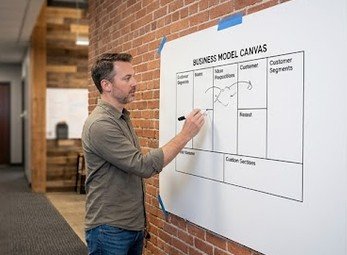
Business Model Canvas: Ditch the 50-page business plan. Use a dynamic, single-page canvas to map out your hypotheses regarding value proposition, customer segments, channels, and revenue streams.
"Get Out of the Building": Stop debating features in a conference room. Founders must personally interact with potential customers to test their hypotheses and understand real pain points from day one.
Agile Development: Instead of long, multi-year product development cycles, use agile engineering to build products iteratively and incrementally.
The Minimum Viable Product (MVP): Build the simplest possible version of your product that allows you to start the learning process. An MVP isn't about launching a subpar product; it's about maximizing learning with minimal effort.
Build-Measure-Learn Feedback Loop: The core engine of a startup is to turn ideas into products, measure how customers respond, and then learn whether to pivot or persevere.
The Pivot: When your initial hypotheses are proven wrong (and they often will be), you must pivot—making a structural course correction to test a new fundamental hypothesis without abandoning the overall vision.
Conclusion
The narrative that the typical corporate path is the only route to success is crumbling. Record numbers of professionals—notably women fed up with a broken, inequitable system, and midlife workers seeking profound fulfillment—are realizing that the corporate ladder is often leaning against the wrong wall.
However, abandoning this path to launch a company is not for the faint of heart. The graveyard of startups is filled with founders who tried to apply corporate execution to a venture built on uncertainty. By embracing the reality that launching a company is immensely difficult, and by adopting the agile, customer-centric principles of the Lean Startup, today’s career changers can mitigate the risks. The pivot from employee to entrepreneur is a profound challenge, but for those willing to unlearn their corporate habits, it offers the ultimate reward: the freedom to build something that truly matters.