
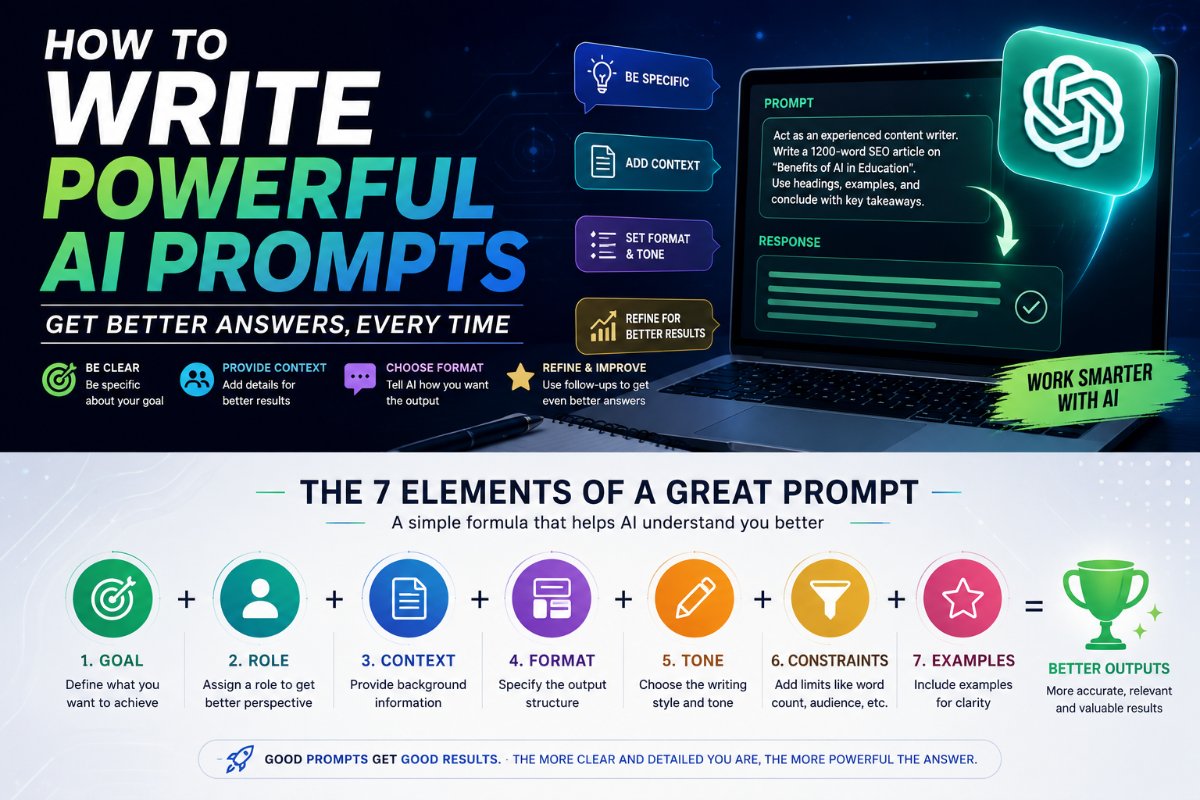
Artificial intelligence has become an essential tool for writing, coding, research, business, and creativity. However, one factor determines whether you receive an average answer or an outstanding one: the quality of your prompt.
A prompt is simply the instruction you give an AI. The better your prompt, the better the response.
This guide explains everything you need to know about writing effective prompts, common mistakes to avoid, and proven techniques that professionals use every day.
What Is a Prompt?
A prompt is the message or instruction you provide to an AI model such as ChatGPT.
For example:
Poor Prompt
Write about smartphones.
This instruction is too vague.
Better Prompt
Write a 2,000-word SEO article about the best smartphones under £500 in 2026. Include headings, comparisons, FAQs, and a conclusion.
The second prompt provides clear expectations, making it much easier for the AI to deliver a useful response.
Why Prompt Writing Matters
ChatGPT doesn't "guess" what you want. It responds to the information you provide.
A well-written prompt helps the AI understand:
Your goal
The target audience
The writing style
The preferred format
The amount of detail
Any specific requirements
The more context you provide, the more accurate and relevant the answer is likely to be.
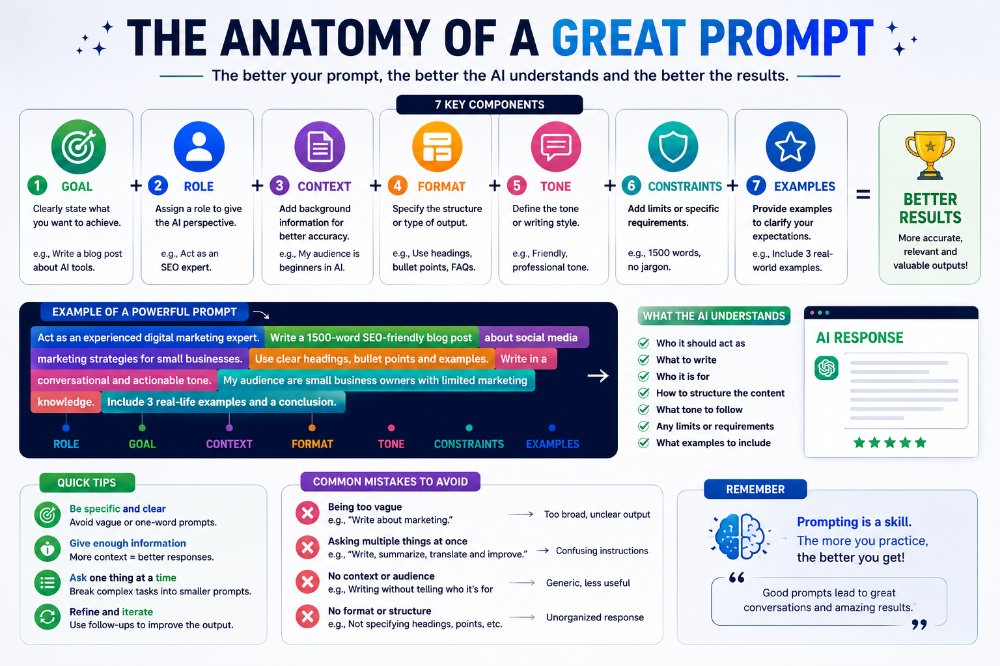
The Formula for a Great Prompt
A simple framework that works for almost any task is:
Role + Task + Context + Format + Constraints
For example:
Act as an experienced technology journalist. Write a 1,500-word beginner-friendly article explaining quantum computing. Use simple English, include real-world examples, FAQs, and optimise it for SEO.
This prompt tells the AI:
Who it should act as
What to do
Who the audience is
How the content should be structured
What style to follow
The 7 Elements of an Effective Prompt
1. Define the Goal
Start by explaining exactly what you want.
Instead of:
Tell me about AI.
Write:
Explain artificial intelligence to beginners with real-world examples.
2. Assign a Role
Giving the AI a role often leads to more focused responses.
Examples:
Act as a software engineer.
Act as an SEO expert.
Act as a history teacher.
Act as a travel guide.
Act as a business consultant.
Each role encourages a different style and level of detail.
3. Provide Context
Context improves relevance.
Example:
Instead of:
Write an email.
Try:
Write a professional follow-up email to a client after a product demonstration. Keep it polite and under 200 words.
4. Specify the Format
Tell ChatGPT how you want the information presented.
Examples include:
Blog article
Table
Bullet points
Checklist
Email
Presentation
Social media post
YouTube script
FAQ
5. Mention the Tone
The same content can be written in different ways.
Examples:
Professional
Friendly
Conversational
Formal
Persuasive
Humorous
Technical
Simple English
6. Add Constraints
Constraints help narrow the response.
Examples:
500 words
No technical jargon
Include five examples
Use British English
Optimise for SEO
Suitable for beginners
7. Ask for Examples
Examples make content easier to understand.
Instead of:
Explain machine learning.
Try:
Explain machine learning using three real-world examples.
Before and After Prompt Examples
Article Writing
Poor Prompt
Write an article on fitness.
Better Prompt
Write a 2,000-word SEO article about home workouts for beginners. Include H2 headings, FAQs, expert tips, and a conclusion.
Coding
Poor Prompt
Write Python code.
Better Prompt
Write a Python program that reads a CSV file, removes duplicate rows, and saves the cleaned data to a new CSV. Add comments explaining each step.
YouTube Script
Poor Prompt
Write a script.
Better Prompt
Write a 10-minute YouTube script about electric cars. Include a strong hook, storytelling, facts, transitions, and a call to action.
Poor Prompt
Write an email.
Better Prompt
Write a polite follow-up email thanking a customer for attending a meeting and summarising the next steps.
Common Prompting Mistakes
Many people receive disappointing AI responses because they:
Ask vague questions
Leave out important details
Forget to mention the target audience
Ignore formatting requirements
Expect the first answer to be perfect
Don't refine the prompt after seeing the first response
Prompting is an iterative process. Small changes can lead to much better results.
Advanced Prompting Techniques
Chain Prompting
Break a large task into smaller steps.
Instead of asking for an entire business plan at once, ask:
Generate business ideas.
Choose the best idea.
Create a business model.
Develop a marketing strategy.
Estimate costs.
This often produces more organised and detailed results.
Iterative Prompting
Use follow-up prompts to improve the answer.
Examples:
Make it shorter.
Add more examples.
Rewrite it in simple English.
Optimise it for SEO.
Add statistics.
Make it sound more professional.
Comparative Prompting
Ask the AI to compare options.
Example:
Compare ChatGPT, Claude and Gemini in a table for students, programmers and content creators.
Perspective Prompting
Ask the AI to answer from a specific viewpoint.
Examples:
Explain this as a lawyer.
Explain this as a teacher.
Explain this as a CEO.
Explain this as if I'm 10 years old.
Prompt Templates You Can Copy
SEO Article
Write a 2,000-word SEO article about [topic]. Include H2 and H3 headings, FAQs, examples, a conclusion, and a meta description. Write in simple English.
Blog Post
Write a friendly blog post about [topic]. Include practical tips, examples, and a summary.
Social Media
Create 20 Instagram captions about [topic] with relevant hashtags.
Product Description
Write a persuasive product description for [product]. Highlight key features, benefits, and include a call to action.
Resume
Improve my resume for a software engineering position. Make it ATS-friendly and achievement-focused.
Learning
Teach me [topic] from beginner to advanced with quizzes and practical exercises after each section.
Tips for Better Prompt Writing
Be clear and specific.
Give enough background information.
Mention the audience.
Define the desired output.
Include formatting instructions.
Specify tone and style.
Request examples where helpful.
Refine the prompt based on the AI's response.
The best prompts evolve through conversation. Don't hesitate to ask follow-up questions or request revisions.
Is There a Perfect Prompt?
No.
The most effective prompts are tailored to the task. A prompt that works well for coding may not be suitable for creative writing or business planning.
Learning how to adapt your prompts to different situations is more valuable than memorising a single template.
Final Thoughts
Writing effective prompts is one of the most valuable AI skills you can develop. A thoughtful prompt can transform ChatGPT from a simple chatbot into a capable writing assistant, tutor, programmer, researcher, and creative partner.
As AI tools continue to evolve, prompt writing will remain an essential skill for professionals, students, entrepreneurs, and creators alike. The more clearly you communicate your goals, the more useful and accurate the AI's responses will become.